
Participating Artist
Laila Tara H & Monir Shahroudy Farmanfarmaian
Informations
June 11 → July 25, 2026
40 rue Mazarine, 75006
Paris, France
Press Release
Hir o Vir takes its title from a Persian expression referring to a state of productive disorder: that moment of instability when forms have not yet found their coherence, yet something is already in the process of emerging.
The exhibition draws upon this liminal condition to bring into dialogue Laila Tara H and Monir Shahroudy Farmanfarmaian, a major figure of modern Iranian art whose work has resonated internationally for decades. Across two generations of women artists, fragmented memories encounter highly structured formal systems. Geometric forms multiplied through repetition coexist with fleeting images that the eye struggles to retain; artisanal precision meets intuitive emergence. Hir o Vir explores the tensions between order and dispersion, permanence and alteration (in the sense of decline, deterioration, or even disintegration). The exhibition proposes a suspended space in which the image never appears as a stable given, but rather as the provisional result of an ongoing process of composition and decomposition.
One form runs throughout the exhibition: the ball. An elemental figure, it appears suspended in a state of indeterminacy from which a narrative tension emerges even before any story has been articulated. Neither entirely falling nor completely still, Laila Tara H’s works, whether memory drawings built around a collection of stamps, paper compositions reminiscent of garment patterns, or bronze marbles, establish a temporality of anticipation, shaped by suspension and suspense. A suspended triptych of forms evoking the kaftan is by turns diaphanous, fragile and reflective through its use of gampi paper, hemp paper and polished steel, oscillating between sketch, garment, relic and apparition.
Associated with childhood and play as much as movement and impact, the sphere becomes here an ambiguous object: both intimate and monumental, vulnerable and emotionally charged. Deployed through a material vocabulary combining graphite, paper, steel, brass and bronze, it simultaneously evokes the gesture of drawing, an industrial memory, and regimes of erasure and reflection. In turn, Monir Shahroudy Farmanfarmaian’s mirrored work initiates and extends this dialogue. Constructed through a rigorous system of repetitions, symmetries and permutations, it generates an order whose stability always remains relative. The longer one looks, the more its forms seem to multiply, shift and produce new configurations. Where Laila Tara H reconstructs the image from fragments of memory, Monir generates disturbance from a structure that appears perfectly ordered. Presented on a low pedestal recalling the howz, the interior pools found in traditional Iranian domestic architecture, the work functions as a fragile point of equilibrium around which the exhibition articulates its relationships to time, perception and the recomposition of images. Its reflection projects onto the ceiling like luminous ripples across the surface of still water, while the red elements dispersed throughout the composition introduce a subtle disruption into the geometric framework. Like a fractal pattern unfolding from a single point of origin, they suggest the silent propagation of an impact whose reverberations continue to spread long after the event itself has passed.
Hir o Vir presents a dialogue displaced across time and space between two practices that each interrogate, through distinct yet interconnected visual languages, the fragile construction of memory in image form, that instant before impact resounds, before the alarm sounds, before the ground begins to tremble. Where Monir Shahroudy Farmanfarmaian’s geometric rigor, mirrored surfaces and repetition produce an apparently stable order traversed by internal complexities and fragmentary effects, Laila Tara H’s practice unfolds as a singular exploration of contemporary craft through a form of neo-miniaturism in which technical precision and mnemonic failure inevitably coexist. Drawing upon techniques inherited from Persian traditions and relocating them within a deeply personal language, her work brings forth images from fragments, memories, deliberately incomplete forms and suspended architectures oscillating between garment, relic and apparition. The detail of motifs, figures, letters and fields of colour speaks less of demonstrative virtuosity than of an active principle of doubt. In other words, a continual attempt to deconstruct and reconstruct the architecture of memory.
Courtesy of Parand Danesh
Read more
Monir Shahroudy Farmanfarmaian (1922–2019) was a pioneering Iranian artist celebrated for her mirror mosaics, reverse glass painting, and geometric sculptures that bridged Persian craftsmanship with modern abstraction. Drawing on the traditions of Islamic geometry and the Iranian decorative technique of aineh-kari (mirror mosaic), her work explored the interplay of light, reflection, color, and architectural form.
After studying at the Fine Arts College in Tehran, Farmanfarmaian moved to New York in 1945, where she attended the Parsons School of Design and became part of the postwar art scene alongside artists such as Andy Warhol, Jackson Pollock, and Frank Stella. Her practice uniquely merged the visual language of Iranian architecture and craft with the formal concerns of contemporary Western abstraction.
Her work has been the subject of major international exhibitions at institutions including the Solomon R. Guggenheim Museum, Victoria and Albert Museum, High Museum of Art, and Irish Museum of Modern Art. She also participated in several editions of the Venice Biennale, representing Iran in 1958, where she received a gold medal. Her works are held in major public collections worldwide, including the Metropolitan Museum of Art, Tate Modern, and the Museum of Fine Arts, Houston. In 2017, the Monir Museum was inaugurated in Tehran in honor of her life and artistic legacy.
Laila Tara H (b. 1995) is a British-Iranian artist whose multidisciplinary practice spans painting, textile, sculpture, and installation. Her work integrates a wide range of materials, including natural pigments, handmade paper, textiles, wood, and metals. These materials facilitate a complex interplay between cultural history and subjective memory, reflecting her critical engagement with both historical legacies and contemporary realities. Drawing from Persian craft traditions such as Indo-Persian miniature painting, poulak-douzi embroidery and souzani textiles, Tara H constructs a visual language that merges historical influences with contemporary expression.
Selected solo and duo exhibitions include Hastan at Copperfield, London (2023), Twisted toes, tangled ears at Public Gallery, London (2022), and Vexilloid at O Gallery, Tehran (2021). Her residencies include Sarabande: Alexander McQueen Foundation, VO Curations, and Blank100 Residency. Tara H has also collaborated with Home of Hai, Drake’s London, and The Twenty Two. Her works are held in major international collections including the Kiran Nadar Museum / Scorpion Collection (Delhi), MAIIAM Contemporary Art Museum (Chiang Mai), and the Taimur Hassan Collection.
Read more

Installation views, ‘Hir o Vir’ by Laila Tara H and Monir Shahroudy Farmanfarmaian, Hatch Gallery, Paris, 2026. © Pauline Assathiany. Courtesy of the artist and Hatch Gallery.

Installation views, ‘Hir o Vir’ by Laila Tara H and Monir Shahroudy Farmanfarmaian, Hatch Gallery, Paris, 2026. © Pauline Assathiany. Courtesy of the artist and Hatch Gallery.
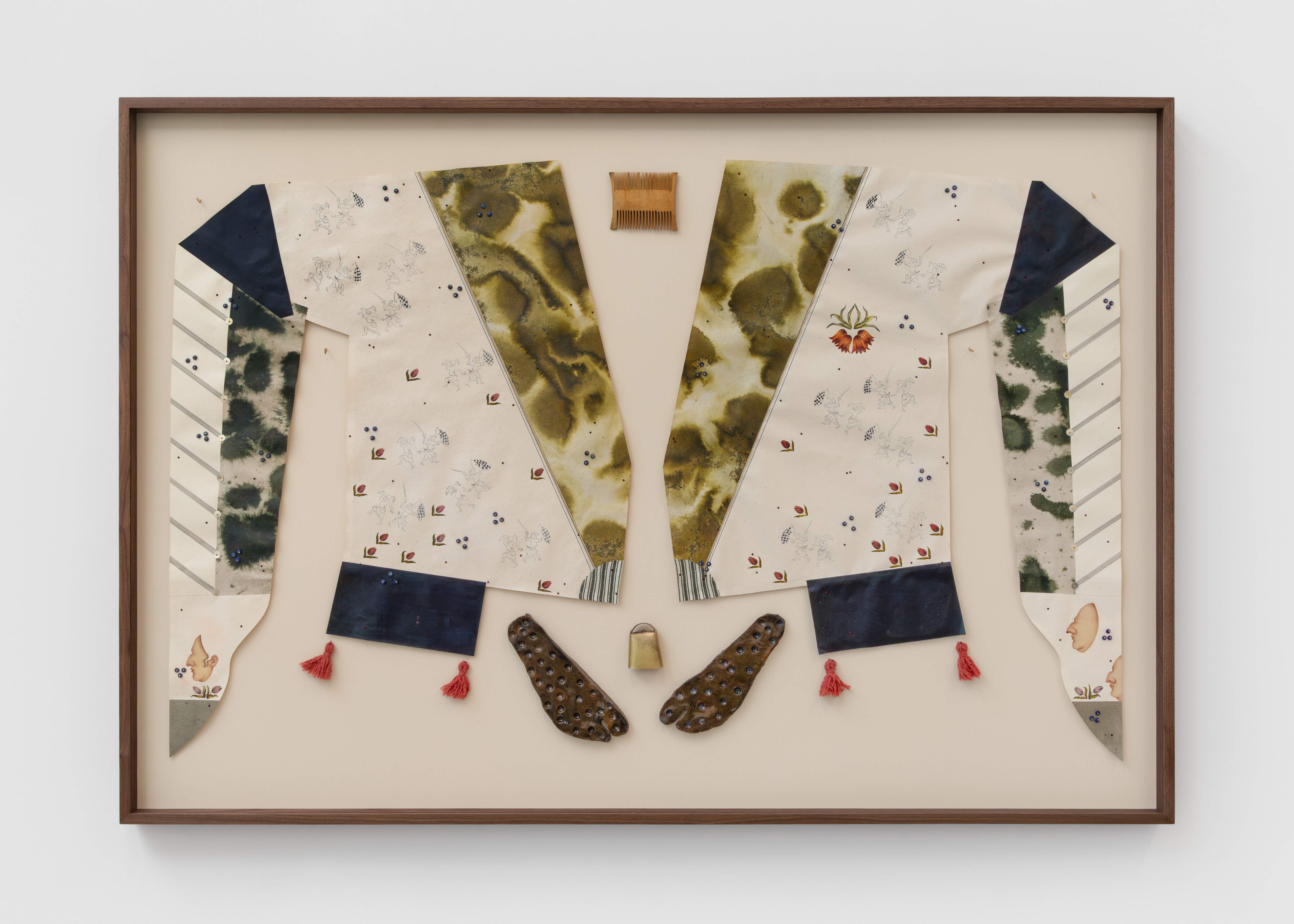
Laila Tara H
Summary (Loqmé 3)
2026
Hemp paper, indigo, ceramic, pigment, wooden comb, brass bell, sequin, beads, gum Arabic, watercolour, thread, lapis lazuli, ink, shell gold, brass poulak, wool tassel, cast brass, starch glue
100 × 145 cm

Installation views, ‘Hir o Vir’ by Laila Tara H and Monir Shahroudy Farmanfarmaian, Hatch Gallery, Paris, 2026. © Pauline Assathiany. Courtesy of the artist and Hatch Gallery.

Laila Tara H
Summary (Loqmé 3)
2026
Details

Laila Tara H
Summary (Loqmé 3)
2026
Details

Laila Tara H
Contact (Loqmé 4)
2026
Details

Laila Tara H
Contact (Loqmé 4)
2026
Details

Laila Tara H
Contact (Loqmé 4)
2026
Stainless steel ball, gampi paper, wax paper, ink, walnut frame
100 × 145 cm

Laila Tara H
Match
2026
Details

Laila Tara H
Match
2026
Details

Installation views, ‘Hir o Vir’ by Laila Tara H and Monir Shahroudy Farmanfarmaian, Hatch Gallery, Paris, 2026. © Pauline Assathiany. Courtesy of the artist and Hatch Gallery.

Laila Tara H
Match
2026
Hemp paper, pencil, pigment, gum Arabic, watercolour
78.5 × 98 cm

Laila Tara H
Match
2026
Hemp paper, pencil, pigment, gum Arabic, watercolour
78.5 × 98 cm
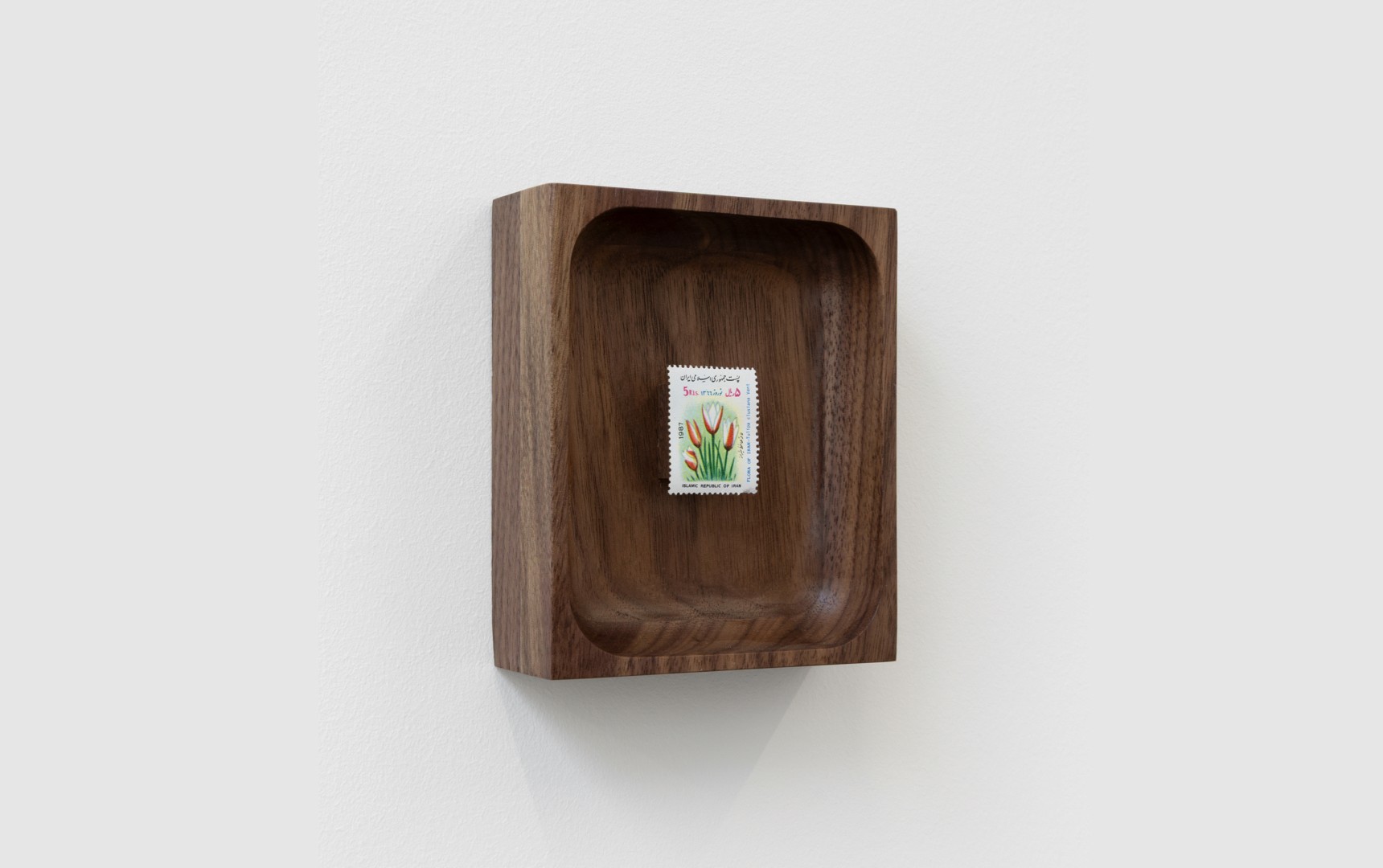
Laila Tara H
Components (Loqmé 3, key)
2026
Details
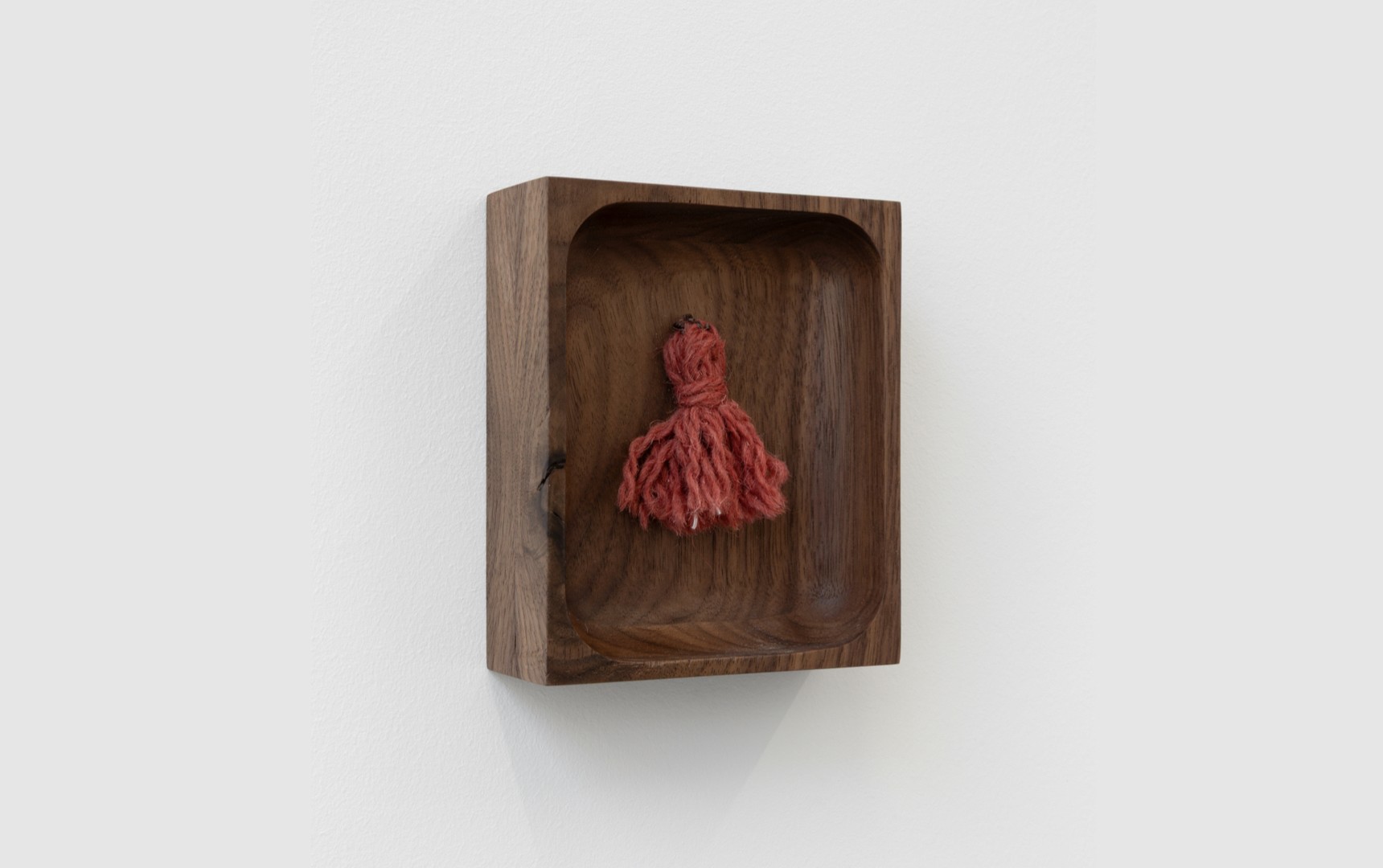
Laila Tara H
Components (Loqmé 3, key)
2026
Details

Laila Tara H
Components (Loqmé 3, key)
2026
Brass ball, wool tassel, cast brass moth egg, 1986 stamp, comb fragment
10 × 12 cm (each)

Installation views, ‘Hir o Vir’ by Laila Tara H and Monir Shahroudy Farmanfarmaian, Hatch Gallery, Paris, 2026. © Pauline Assathiany. Courtesy of the artist and Hatch Gallery.

Laila Tara H
Contact (Loqmé 5)
2026
Details

Laila Tara H
Contact (Loqmé 5)
2026
Mirror-polished steel, galvanised steel handles, brass sphere
100 × 145 cm

Installation views, ‘Hir o Vir’ by Laila Tara H and Monir Shahroudy Farmanfarmaian, Hatch Gallery, Paris, 2026. © Pauline Assathiany. Courtesy of the artist and Hatch Gallery.

Studio Views of Laila Tara H. Preliminary research for exhibition Hir or Vir, 2026. © Laila Tara H. Courtesy of the Artist and Hatch Gallery.

Monir Shahroudy Farmanfarmaian. © Photo: Courtesy of the Artist and The Third Line
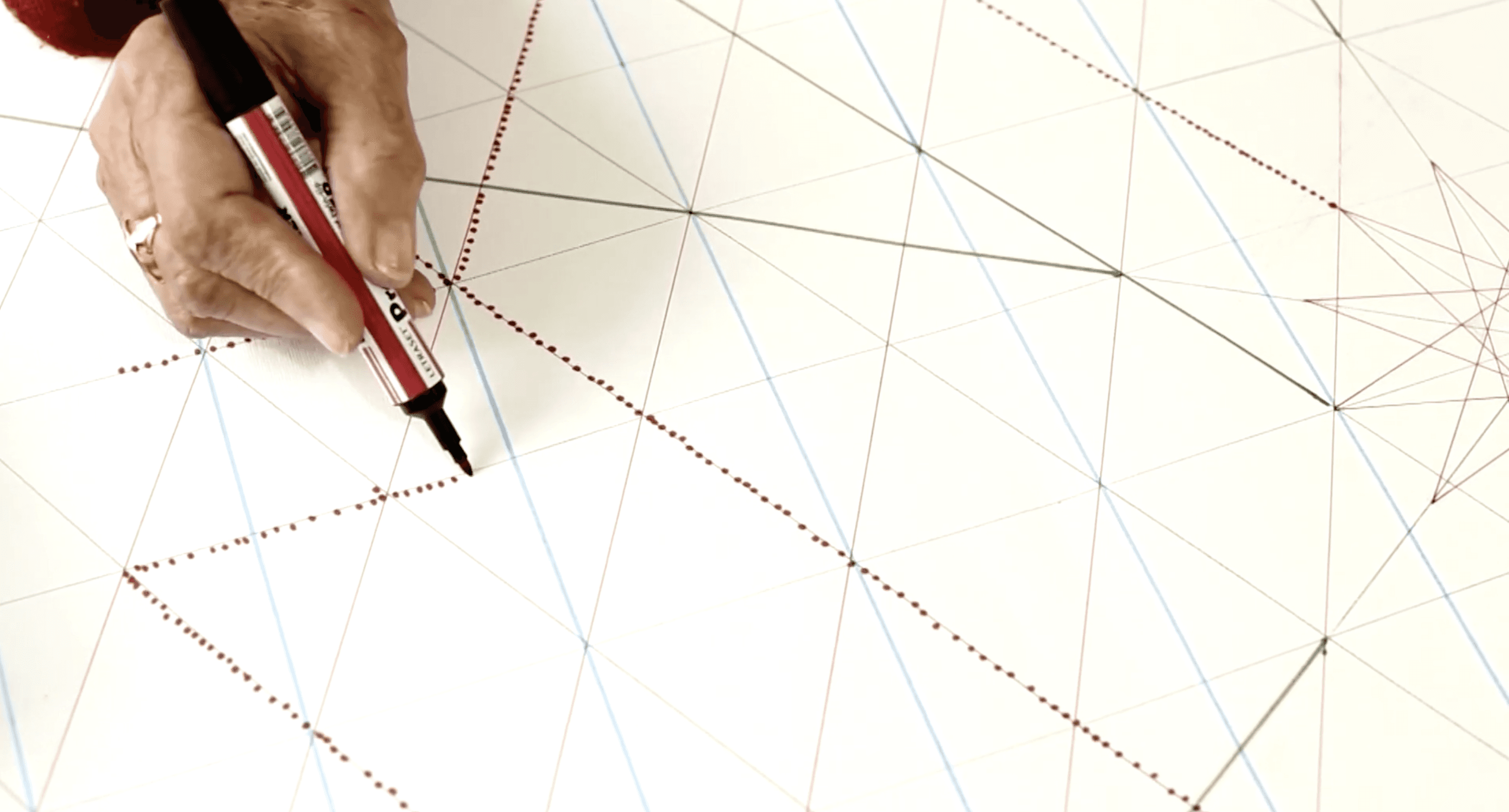
Studio Monir Shahroudy Farmanfarmaian. Still from Film’ Monir" (2013). Courtesy of the Artist, Sepideh Honarmand and Leyla Fakhr Productions.

Studio Views of Laila Tara H. Preliminary research for exhibition Hir or Vir, 2026. © Laila Tara H. Courtesy of the Artist and Hatch Gallery.