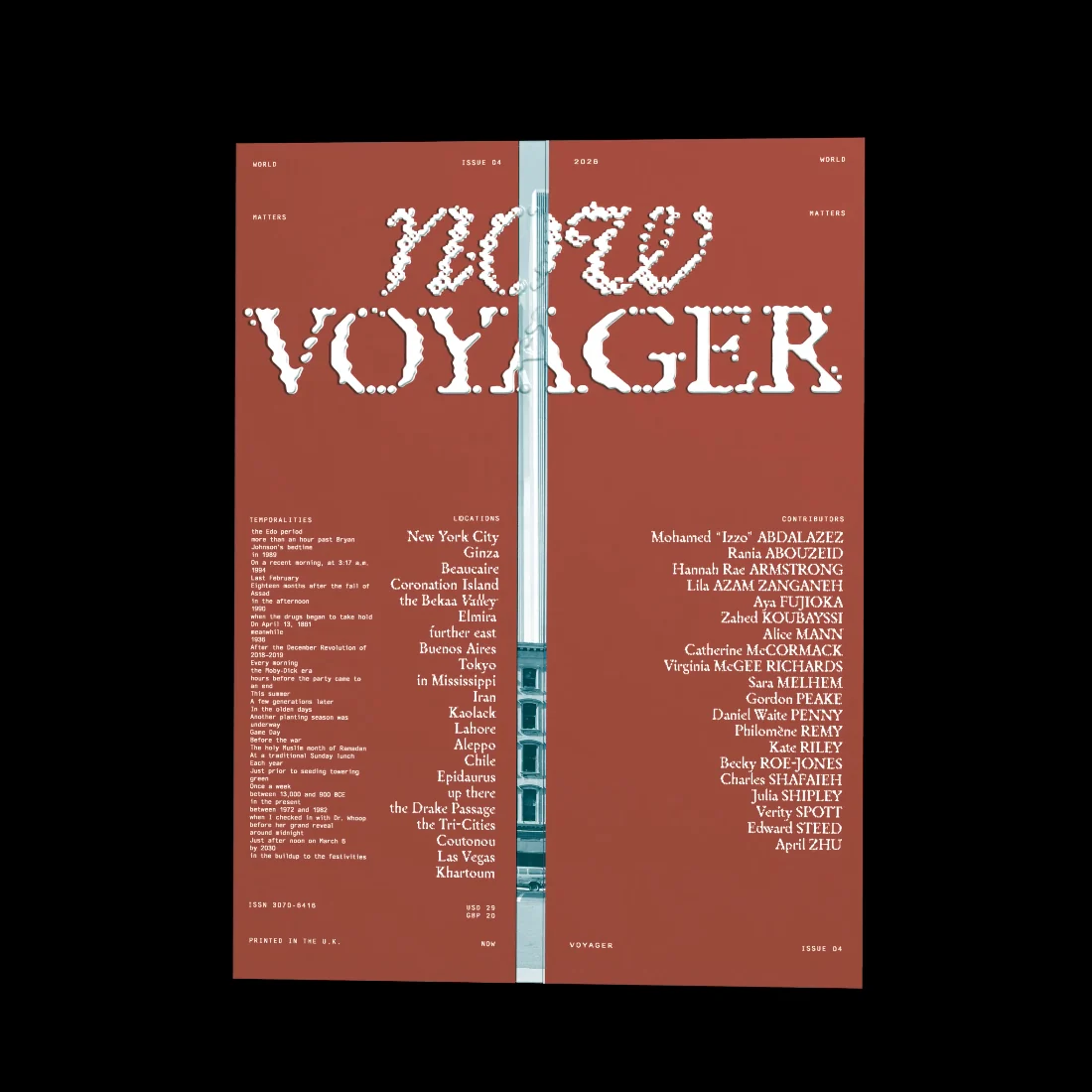
"Women Without Men" : Laila Tara H featured in Now Voyager Issue 4
“Women Without Men,” with text by Lila Azam Zanganeh, brings together the work of Monir Shahroudy Farmanfarmaian, Shirazeh Houshiary and Laila Tara H, reflecting on art, memory, identity and the connections between Iran and the West across three generations of women artists.
THREE WOMEN WITHOUT MEN. Three women straddling geographies, their lives halfway between Iran and the West. Three women cutting through time. Two are famous; the other not just yet.
Monir Shahroudy Farmanfarmaian was a contemporary artist from Iran who died in 2019, at the age of ninety-six. There’s a museum in Tehran named after her, the Monir Museum, but it avoids the old world resonance of her regal family name, Farmanfarmaian. Twice married, Monir was embedded in the New York art scene for decades, and spent the first years of the revolution doing calligraphy and wondering to herself if Ayatollah Khomeini would stay in power. (“Yes, the old man will stay,” a medium told my mother in 1979.) She made hexagons of wood and mirror, and painted glass, overlaying minimalism with Persian decorative arts. When Andy Warhol died in 1987, a mirror-speckled ball she’d given him when he’d travelled to Iran was still perched in his living room.
Shirazeh Houshiary, seventy-one, was born in Iran and now lives in London. She weaves elements of Iranian tradition into her sculptures and paintings, transcending limitations by expanding her cultural register. She plays with Arabic scripts and spectral colors that span the worlds of the living and the ghostly. Mists and sprays are layers within a palimpsest of science and pigments. “Everything is in a state of erosion,” she says, “and yet we try to stabilize it. This tension fascinates me, and it’s at the core of my work.”
Laila Tara H is thirty-one, the granddaughter of Iranian immigrants, and a woman with free rein to find the forms of her desire. Her studies in miniature at the School of Traditional Arts in London inspired her to make medieval miniatures new again. She uses paintbrushes so minute as to employ only a single kitten hair. Her images are an act of rebellion: She juxtaposes tradition with daring and invention, bringing together geometric shapes, natural pigments, and the age-old craft of sewing golden coins onto cloth. “I produce what I think is mine,” she says, “in my own place and time.” Miniatures in Iran were produced by schools of men, under the patronage of a king, in the time of the Mongol invasions. We seem to be in a similar moment today, she says, at a crossroads: How, she asks through her pieces, were these artists dealing with loss and the threat of loss?
The works of these three women share commonalities in their use of mirrors and the color green. As in Shahrnush Parsipur’s novel Women Without Men, published in 1989, green symbolizes life and the everlasting spirit.
Green, the color of pools, of reflecting water, of the fractured, shimmering mirror. The color of Islam, of paradise. Indeed, Islam is present in the works of these women, like a steady hum, a melody, a mystical alphabet. The alphabet of tradition, like the Mosque of Shah Cheragh (or King of Light), which inspired Monir. The twinned artistry of the Persian and Islamic traditions. Towers of worship murmuring in stark light. The light reflecting off bricks, affording multiple perspectives, like a dream.
There is identity, generation, and grief in the works of Monir, of Shirazeh, of Laila. Something, always, is left behind. Rumi brushes upon this, in “Bird Wings”:
Your grief for what you’ve lost lifts a mirror
up to where you are bravely working.
Expecting the worst, you look, and instead,
here’s the joyful face you’ve been wanting to see.
Your hand opens and closes, and opens and closes.
If it were always a fist or always stretched open,
you would be paralyzed.
Your deepest presence is in every small contracting
and expanding,
the two as beautifully balanced and coordinated
as bird wings.
Grief transmutes into a mirror: the work itself. What can it be now, this ancient image?
Everything in the work of these women artists is contraction and expansion. Expansion and contraction. A heartbeat, the flap of a bird wing, a reckoning with the past, in the present.
History meets memory and grief. What is lost, what can be regained? Not by rote or repetition. Rather, a tradition that, perforce, breaks with itself. It plunders all wares, makes new alchemies.
Three women without men, each splintering and reassembling time.
Text by Lila AZAM ZANGANEH